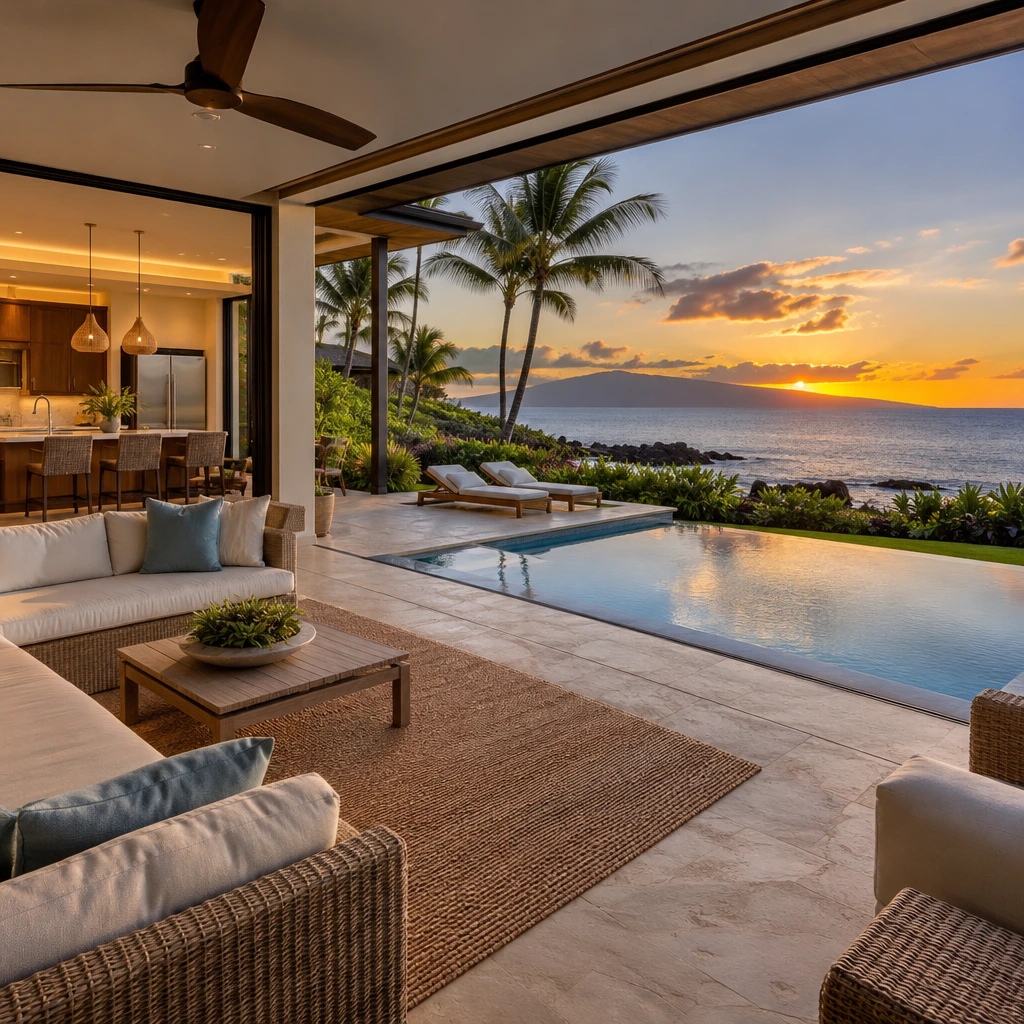
Designing a flexible Maui home means planning for more than one chapter of ownership. A condo in Wailea, a residence in Kula, or a second home in Napili may serve as a personal retreat today, a long-term rental later, or a furnished property transition if plans change. The best interiors make those shifts practical without looking temporary or overly commercial.
For Maui owners, that flexibility is especially important as rental regulations evolve. Maui County’s Bill 9 phases out transient vacation rental use in certain apartment-zoned properties beginning January 1, 2029, in West Maui and January 1, 2031, in other areas, according to the Maui County Council’s Bill 9 overview. The law affects the furnishing decisions owners make today, even when a property is still operating as a vacation rental.
This guide explains how to create a Maui home that can support personal use, a long-term tenant, or another permitted rental strategy. It covers durable materials, multi-purpose furniture, owner’s closet design, remote project management, island freight, and the different needs of South Maui, West Maui, Upcountry, and the North Shore. Byline: Valorie Spence, ASID, owner of IDS Maui, designing Hawaii homes since 1999.
How do you design a flexible Maui home for personal use or long-term rental?
Start with a neutral, durable foundation and add personality through pieces that can move, be replaced, or serve more than one purpose. A flexible plan should feel welcoming to an owner while remaining comfortable, maintainable, and practical for a future long-term resident.
Build around adaptable zones
Instead of designing every room for one fixed activity, create zones that can change over time. A dining area might include a table that works for family meals, remote work, or tenant paperwork. A guest room can accommodate visitors, a home office, or a resident’s bedroom. In smaller Maui condos, a sleeper sofa or wall-bed system can provide occasional sleeping space without making the living room feel like a hotel suite.
Multi-purpose furniture Maui homeowners often find useful includes:
- Dining tables with durable finishes and comfortable work height.
- Sleeper sofas with performance upholstery for visiting family or tenant guests.
- Storage ottomans that function as seating, luggage stands, and concealed storage.
- Console tables that can become entry drop zones or compact workstations.
- Indoor-outdoor pieces that move easily between a covered lanai and interior rooms.
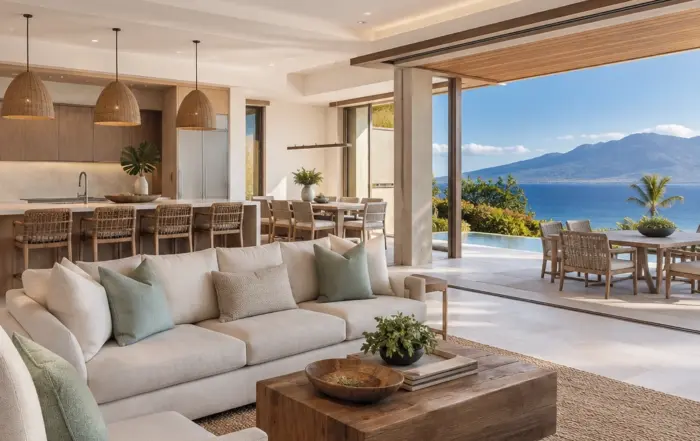
The goal is not to make the home generic. Instead, select a restrained base—quality flooring, well-scaled case goods, durable upholstery, and lighting that suits the architecture—then layer in art, accessories, and color that reflect the owner’s relationship with Maui.
Plan for the property’s actual microclimate
Material choices should respond to location. Wailea, Makena, and Kihei receive intense sun, salt air, and heat. Kaanapali, Kapalua, Napili, and Lahaina share many of those leeward conditions. Upcountry communities such as Makawao, Kula, Pukalani, and Haiku are cooler and damper, making mildew prevention, ventilation, fireplaces, and warmer palettes more relevant. Paia, Spreckelsville, and Hana are windward and humid, with additional concerns about rust and moisture.
A successful Maui long-term rental design is therefore not simply a vacation-rental package with fewer decorative items. It is a home planned for daily living, local weather, maintenance access, and the possibility that the people using it may stay for months or years.
What are the Maui Bill 9 design implications for owners?
Bill 9 makes flexibility a financial and practical consideration for some owners. Maui County states that the ordinance phases out transient vacation rental use in apartment zoning districts, with the West Maui deadline beginning in 2029 and the deadline for remaining areas beginning in 2031. The County also reported that 6,208 Minatoya-listed units were actively operating as short-term rentals as of May 29, 2024. Read the County’s announcement about Bill 9 becoming law for the official context.
This does not mean every Maui property has the same future. Hotel- and resort-zoned properties, permitted bed-and-breakfast homes, permitted short-term rental homes, and other categories may be treated differently. Rules can change, and zoning, permits, condominium documents, and use restrictions all matter. Owners should confirm the current status of a specific property with Maui County rather than relying on a furnishing professional for legal advice. The County’s official short-term rental information is a useful starting point.
Design for a graceful transition
If a vacation rental may become a long-term rental, avoid expensive furnishings that are optimized only for frequent guest turnover. Long-term residents need comfortable reading chairs, practical bedside storage, adequate closet space, a functional kitchen, and furnishings that tolerate everyday use. A property intended for personal use may need better artwork, more individualized styling, and flexible storage for owner belongings.
For a Maui property transition furnishing plan, consider:
- A concealed owner’s closet that can be secured when the home is rented.
- Durable upholstery that still feels residential rather than institutional.
- Bed frames with accessible replacement parts and standard mattress sizes.
- Case goods that can be repaired or refinished on island when possible.
- Lighting and window treatments that support both privacy and natural ventilation.
- Open shelving used selectively, with closed storage for easier maintenance.
In resort-zoned properties that remain eligible for vacation rentals, the strategy is different. The furnishings must continue to photograph well, support occupancy, and withstand frequent arrivals, luggage, sunscreen, wet swimwear, and repeated cleaning. In that setting, contract-grade construction, performance fabrics, durable case goods, sleeper sofas, and a planned five-year soft-goods refresh can protect the property’s appeal.
What furniture and materials hold up to Maui’s salt air and humidity?
The strongest choices combine performance with a residential appearance. Look for powder-coated or appropriately finished metals, sealed wood, high-quality laminates, solid construction, and fabrics rated for demanding use. Outdoor furniture should be selected for the actual exposure of the lanai—not simply because it is labeled “outdoor.” Covered spaces still receive humidity, airborne salt, wind-driven rain, and intense UV.
Should you use rattan, leather, wool, jute, or sisal in Hawaii?
Rattan can work beautifully in Maui when it is correctly specified and kept in a suitable location, but natural fibers require attention in damp environments. Leather can be comfortable and durable, particularly in conditioned interiors, although direct sun and salt exposure can accelerate drying, fading, or surface wear. Choose finishes and placements carefully rather than treating any material as universally safe.
Wool rugs are often a good choice for bedrooms and lower-traffic interior areas because they provide warmth and texture. Jute and sisal can be attractive, but they may be vulnerable to mildew in humid homes, especially near open lanais, entryways, or rooms without consistent ventilation. Performance and indoor-outdoor rugs are often better options for high-traffic rooms and covered outdoor areas.
For every rug, use a size that anchors the furniture grouping. A rug that is too small can make an open great room feel disconnected, while an appropriately sized rug helps define the living, dining, and conversation areas without adding walls.
How should location influence the palette?
South and West Maui interiors can benefit from breathable fabrics, UV-conscious window treatments, and finishes that do not show salt residue immediately. Upcountry homes may welcome wool, layered textiles, richer wood tones, fireplaces, and warmer colors, but they still need moisture-aware detailing. On the North Shore and in Hana, use rust-resistant hardware and finishes suited to windward exposure.
Before leaving the island for the off-season, owners should address humidity, mildew, salt, termites, and stored lanai furniture. A property manager or trusted local contact can check for leaks, operate ventilation, and identify small problems before they become expensive repairs.
How long does it take to furnish a Maui home from the mainland?
A realistic furnishing timeline is usually longer than the time required to select furniture. Many items are produced on the mainland, consolidated, shipped by ocean freight, received locally, inspected, and installed. IDS Maui typically plans for 8–12 weeks of production plus freight, depending on the scope, vendor lead times, custom work, and shipping conditions.
For owners hoping to arrive during the holidays or in January, orders are typically best placed by August. That schedule allows time for composition sheets, approvals, production, freight, receiving, freight claims if needed, and installation.
Can I furnish my Maui condo while living on the mainland?
Yes. A remote process can be organized around room-by-room composition sheets, finish samples, floor plans, and 3D renderings approved by email. This gives an off-island owner a clear view of scale, color, and placement before orders are released.
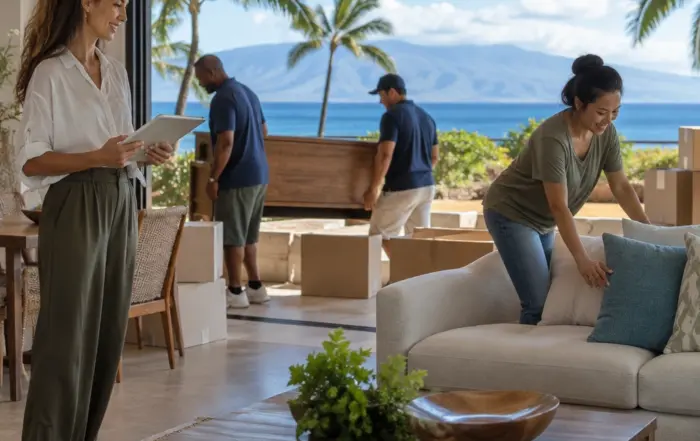
Remote project management should also include more than shopping. The designer may coordinate purchasing, receiving, inspection, freight claims, delivery, installation, and communication with the property manager. The objective is a home ready for the owner’s arrival rather than a collection of boxes waiting at the door.
Freight to Hawaii does not have one universal price. It depends on volume, weight, origin, vendor, crating, consolidation, delivery access, and whether the property is in a condo building or a remote area. A professional estimate should be prepared from the actual order, not a generic percentage. Planning the entire shipment together can also reduce avoidable deliveries and coordination problems.
When should you hire an interior designer for a Maui remodel or new build?
Bring the designer in before electrical and drywall decisions are finalized. Lighting locations, plumbing fixtures, appliances, built-ins, cabinetry, hardware, stone, and furniture scale are interconnected. If those choices are made too late, owners may face expensive changes, unsuitable outlets, limited storage, or rooms that cannot accommodate the intended furnishings.
IDS Maui works with clients’ architects, contractors, and builders, and can coordinate with design-build partners. Cabinetry, stone, and furniture often ship to the island, so selections must be finalized months before completion. Early design involvement is particularly important when a home includes an ohana unit, a lanai-first floor plan, vaulted ceilings, built-in storage, or rooms that must function for both personal use and rental occupancy.
How can a new build stay comfortable without over-relying on air conditioning?
Orientation, cross-breezes, ceiling fans, operable louvers, shaded glazing, and appropriate window treatments can improve comfort while supporting the home’s tropical character. The solution depends on the site. A leeward home in Kihei or Wailea has different solar and wind conditions from a damp Upcountry residence or a windward property near Paia.
Furniture planning should follow those environmental choices. Do not block lanai doors with oversized pieces. Leave comfortable circulation around fans and windows. Select upholstery that can tolerate open-air living. Place artwork and wood furnishings away from the most intense direct sun when possible.
For properties affected by rebuilding or major renovation, design decisions should be handled with care and sensitivity to the community. A thoughtful process begins with the owner’s priorities, the site conditions, the project team, and the practical requirements of long-term maintenance.
Conclusion: How can your Maui home remain useful as your plans change?
The most adaptable Maui home is not designed around a single rental model. It is designed around durability, comfort, storage, maintainability, and the possibility of change. Begin with the property’s zoning and location, then create a furnishing plan that can support personal use, long-term residency, or an eligible vacation-rental strategy without requiring a complete redesign.
Choose materials for the microclimate, reserve space for an owner’s closet, specify multi-purpose furniture, and allow enough time for production and ocean freight. For remote owners, a coordinated design and installation process can make the home ready when they arrive. IDS Maui helps clients plan, purchase, receive, and install furnishings throughout Maui while coordinating with property managers, architects, and builders.
To discuss a flexible Maui home, call 808-891-8800 or email IDS Maui.
Frequently Asked Questions
How much does an interior designer cost on Maui?
There is no single standard fee. Cost depends on the property size, scope, custom work, purchasing, freight coordination, installation, and whether the project is a room refresh, full furnishing, remodel, or new build. Request a project-specific consultation and proposal.
What is quick ship?
Quick ship refers to furniture or materials available from a vendor’s existing inventory or a shorter production program. It can reduce lead time, but it does not eliminate freight, receiving, inspection, or installation time in Hawaii.
Do you work with my contractor or architect?
Yes. IDS Maui can coordinate with your architect, contractor, builder, and property manager so furnishings, lighting, cabinetry, finishes, and installation support the overall project.

Meet Valorie, founder of IDS Maui, who has spent 23 years bringing colorful fabrics, clever space planning, and new technology into homes and workplaces across the Hawaiian Islands, so your project will embody the Hawaiian style.
Need Design Help With Your Maui Home?
Ask us anything — furniture, design, or where to start.