
Three dates now shape almost every furnishing decision in a Maui condominium. Under Ordinance 5909 — the law most people know as Bill 9 — vacation rental use in the County’s A-1 and A-2 apartment districts must stop by January 1, 2029 in West Maui and January 1, 2031 everywhere else, including Wailea, Makena and Kihei. That means thousands of owners are rethinking what their units are actually for: short-term rental, long-term rental, a second home, or a sale. And Maui condo furniture after Bill 9 looks very different depending on which of those paths you choose. A unit built for weekly turnover needs different beds, fabrics, storage and seating than one leased to a resident for a year, and different again from a condo you plan to live in yourself. This guide walks through each path, the timelines that matter, what holds up to salt air and UV, and how to plan orders so the furniture arrives when you need it — not three months after your first tenant.
By Valorie Spence, ASID, owner of IDS Maui, designing Hawaii homes since 1999.
What Does Maui Condo Furniture After Bill 9 Actually Require?
Start with the zoning, not the sofa. Bill 9, CD1, FD1 (2025) passed final reading on December 15, 2025 by a 5–3 vote and took effect that same day as Ordinance 5909, according to the Maui County Council’s announcement of the Bill 9 final reading. It removes the provision that allowed transient vacation rentals in qualifying apartment buildings and sets fixed phase-out dates by district rather than by permit or owner.
The numbers behind the deadline
The properties affected are the ones on the Minatoya list. As of the June 27, 2024 version of that list, it named 104 properties and 7,167 units, and the Department of Finance counted 6,208 Minatoya-listed units actively operating as short-term rentals as of May 29, 2024 — roughly 60 percent of them in South Maui, per this detailed summary of Bill 9 and the Minatoya list. Efforts to carve out exemptions have not gone smoothly: in September 2026 the Maui Planning Commission rebuffed a Council proposal to exclude 3,402 properties from the ordinance, as the Honolulu Star-Advertiser reported on the vacation rental exemption vote.
Two things are not phased out. Hotel-zoned condominiums sit outside the ordinance entirely, which is why resort-zoned properties in Kaanapali and Wailea keep renting as they always have. Validly existing time share units and uses operating under a variance are also exempt. Separately, Ordinance 6008 (Bill 88) created new H-3 and H-4 hotel districts in June 2026 that could, in theory, preserve rental use for specific A-1 and A-2 buildings — but only through a Council rezoning that meets four criteria, and as of late October 2026 no such rezoning vote had appeared on the Council’s published agendas.
Four furnishing paths, four different shopping lists
Practically speaking, owners are choosing among:
- Keep renting short term until the deadline. The ordinance does not end the use when a unit sells, so a buyer can inherit the remaining rental period.
- Switch to a long-term rental. Apartment districts have allowed long-term occupancy since 1989, and a unit rented for twelve consecutive months or more can qualify for the County’s long-term rental tax class.
- Move in or hold. A unit that becomes your principal home, with a home exemption granted, is classed owner-occupied.
- Sell. Staging becomes the priority, and the furnishing budget shifts from durability to presentation.
None of this is legal advice, and rules can change — confirm your own unit’s status with Maui County before you commit to a plan. But once you know your path, the furniture decisions get much simpler.
Long-Term Rental Furnishing on Maui: Build for Tenants, Not Tourists
A twelve-month tenant uses a condo differently than a family on a five-night stay. They cook, they store, they work from home, and they notice when the sofa cushions have gone flat. Long-term rental furnishing on Maui should feel residential first and hospitality-grade second.
What changes when guests become residents
The sleeper sofa usually goes. So does the second Murphy bed. In their place: a real dining table that seats four comfortably, a desk or built-in work nook, generous dresser and closet storage, and lighting you can actually read by. Tenants also expect a washer and dryer, blackout curtains in the bedrooms, and a lanai set they can use year-round rather than a pair of folding chairs.
Durability still matters — just a different kind. Choose performance upholstery with removable, replaceable cushion covers, corrosion-resistant hardware, and case goods with sealed surfaces that tolerate humidity. In Upcountry units, add mildew resistance and warmer palettes; in Kihei and Wailea, prioritize UV fade resistance and salt-air-rated finishes on anything within reach of the lanai.
Where owners overspend
Two mistakes show up repeatedly. The first is buying vacation-rental furniture — thin case goods, lightweight frames — because it was cheaper up front, then replacing it in three years. The second is over-furnishing: filling every corner of a 900-square-foot unit until it feels smaller than it is. Furniture with raised legs and open bases keeps sight lines clear and makes a compact living room read larger.
Maui Condo Staging After Bill 9: Selling, Holding, or Moving In
If your unit is heading to market, Maui condo staging after Bill 9 has a specific job: show buyers what the space can be once the rental calendar comes off the wall. That often means editing rather than adding — removing the owner’s closet clutter, the mismatched nightstands, the beach gear stacked on the lanai.
Staging a unit that no longer generates rental income
Buyers in this segment are weighing a shorter rental window, a long-term lease, or personal use, and they need to see all three. Stage the lanai as a dining room, because in Hawaii it genuinely functions as one. Set the second bedroom as a den or office rather than a bunk room. Keep walkways at roughly 30 to 36 inches so rooms feel easy to move through, and leave the view unobstructed — a sofa placed two feet too far into a sliding door’s path kills a showing.
Presentation also buys patience. A unit that lingers past 100 days on market usually has a story problem, not a furniture problem, and a coherent, well-lit staging plan is the fastest way to fix the story.
Furnishing for personal use
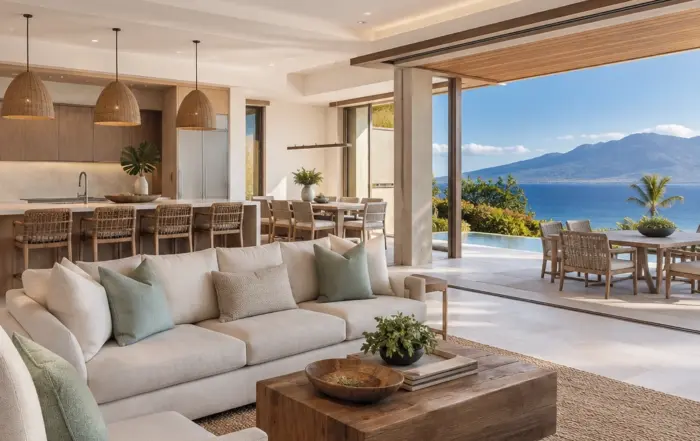
Owners converting to personal use get the most freedom and the most decisions. This is where you can invest in the pieces you actually want: a dining table for entertaining, comfortable lounge seating oriented to the view, rugs that soften a tile floor. If the condo is intended for aging in place, prioritize stable seating with supportive arms, appropriate seat heights, and clear, unobstructed paths from bedroom to bathroom to kitchen.
Resort-Zoned Vacation Rental Furniture on Maui: The Refresh Playbook
Hotel- and resort-zoned condos in Kaanapali and Wailea are unaffected by the phase-out, which means the competitive set is getting sharper, not smaller. Resort-zoned vacation rental furniture on Maui now has to hold its own against newly refreshed inventory across the island.
The working rule from hospitality projects is a five-year soft goods cycle: mattresses, upholstery, linens, rugs and lamp shades. Hard goods — case goods, dining tables, frame construction — should last considerably longer if they were specified correctly the first time. Between cycles, replace cushion cores, tighten hardware, and touch up finishes rather than replacing whole pieces.
Specify for turnover. Contract-grade performance fabrics, sleeper sofas where occupancy justifies them, durable case goods with rounded corners, and an actual owner’s closet with a lock so your personal items and spare supplies stay out of guest photos. Outdoor pieces need outdoor-rated upholstery, corrosion-resistant frames, and finishes built for salt and intense sun — lightweight chairs that migrate in the wind are a maintenance call waiting to happen.
How Long Does It Take and What Does Freight Cost?
Timing is where most remote projects go sideways. Quick Ship items may arrive in roughly two to three weeks. Standard made-to-order pieces can take up to eight weeks. More customized specifications commonly run eight to twelve weeks. Freight to Hawaii is typically about 10 to 15 percent of the item cost and is priced by cubic footage, so a bulky sectional costs far more to ship than its price tag suggests.
The August rule
Production plus freight means orders placed by August are generally ready for a holiday arrival or a January move-in. If you are coordinating a renovation with a fixed rental launch date, work backward from that date and confirm the full landed cost — including delivery, placement and installation — before approving the order. Also measure the delivery path, not just the room: doorways, hallways, the elevator, the stairwell and lanai access all decide whether a piece can get in at all.
Furnishing from the mainland
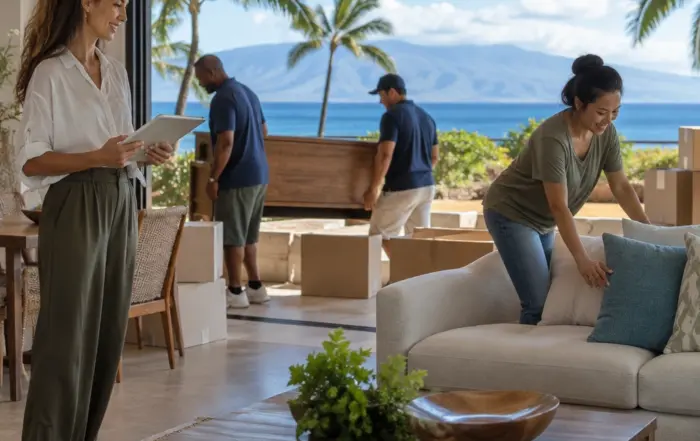
Yes, you can furnish a Maui condo from the mainland. The workable process is room-by-room composition sheets and 3D renderings approved by email, followed by purchasing, receiving, freight claim management and installation while you are away, with the home finished before you land. Coordinate with your property manager on access and delivery windows, and address off-season humidity, mildew and salt before you leave the island.
Frequently Asked Questions
Can I still rent my Maui condo short term? It depends on zoning. Hotel-zoned condominiums are outside Bill 9’s phase-out. A-1 and A-2 apartment-district units may continue through December 31, 2028 in West Maui and December 31, 2030 elsewhere in the County. Confirm your unit’s classification with Maui County directly.
What furniture holds up to salt air and humidity? Performance and solution-dyed fabrics, corrosion-resistant hardware, marine-grade outdoor finishes, and sealed wood or composite case goods. Avoid jute and sisal rugs in humid rooms — they mildew — and choose indoor-outdoor rugs for lanais and high-traffic areas.
Should I buy a sleeper sofa for a long-term rental? Usually not. Long-term tenants need a comfortable primary bed, storage and a workspace more than extra sleeping capacity. Keep the sleeper for short-term and resort-zoned units where occupancy drives revenue.
Conclusion
The phase-out dates are fixed, but your furnishing plan is entirely yours to shape. Owners staying in the short-term market until the deadline should protect revenue with durable, replaceable soft goods. Owners converting to long-term rentals should invest in residential comfort and storage. Owners selling should stage for clarity, and owners moving in should finally buy the pieces they want. What none of them should do is order furniture before the path is decided — the most expensive mistake in this market is a well-built room for the wrong business model.
IDS Maui has been designing Hawaii homes since 1999, working from an Upcountry showroom in Makawao and running remote projects across South Maui, West Maui, the North Shore and Hana. The studio handles space planning, 3D renderings, purchasing, freight claims and installation, and coordinates directly with property managers and contractors. If you are deciding what your condo becomes next, call 808-891-8800 or email the studio through idsmaui.com to talk through a room-by-room plan.

Meet Valorie, founder of IDS Maui, who has spent 23 years bringing colorful fabrics, clever space planning, and new technology into homes and workplaces across the Hawaiian Islands, so your project will embody the Hawaiian style.
Need Design Help With Your Maui Home?
Ask us anything — furniture, design, or where to start.