By Valorie Spence, ASID, owner of IDS Maui — designing Hawaii homes since 1999.
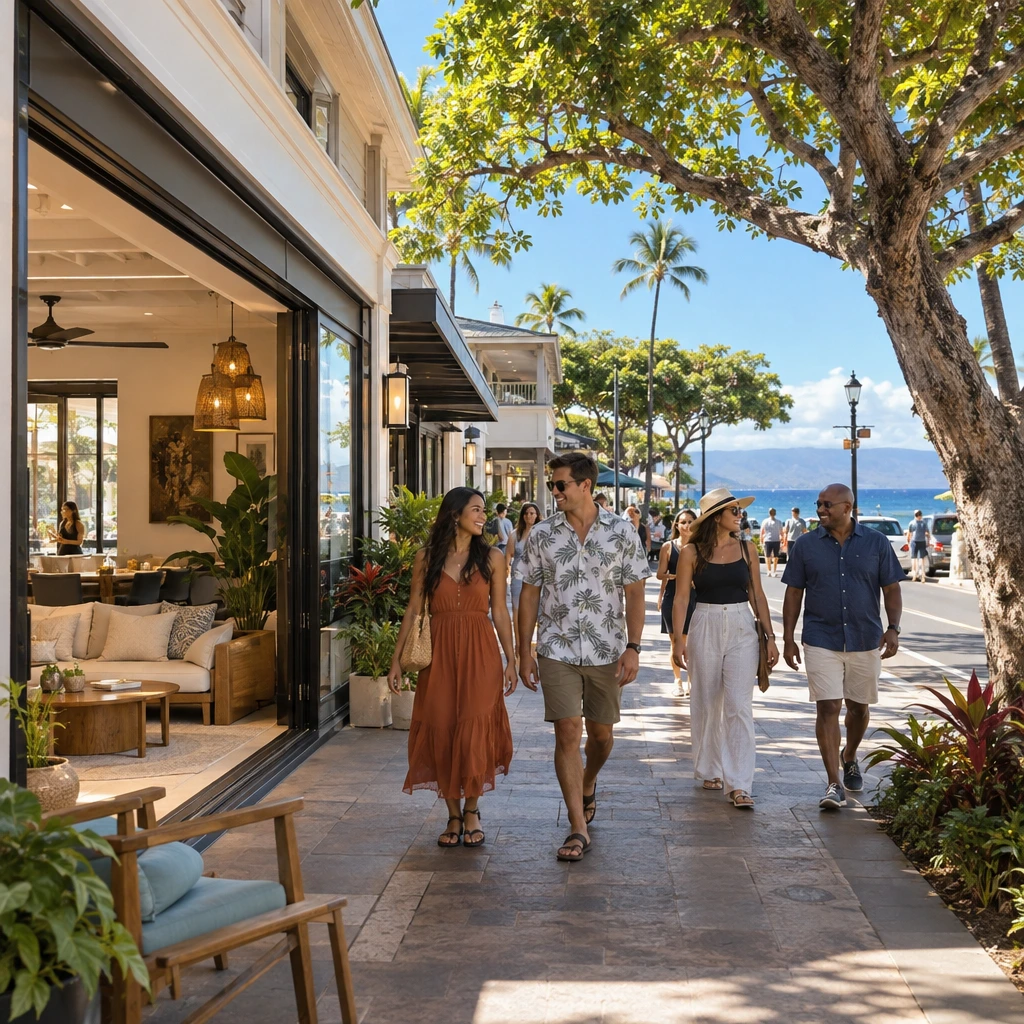
After more than three years of debris removal, seawall repairs and infrastructure work, Front Street in Lahaina reopened to vehicular traffic on Aug. 1, 2026 — and with it came the first real signal that the town’s commercial heart is coming back. The Lahaina Front Street reopening is more than a traffic milestone. It changes how people live along that corridor: a walkable downtown where you step out your door, cross a sidewalk, and land in a marketplace, a restaurant or a harbor view. For homeowners rebuilding or refurnishing nearby, that walkable lifestyle should shape every furnishing decision — from the lanai sofa to the flooring that runs from living room to covered porch.
In this post, we’ll look at what’s actually open on Front Street right now, how walkable indoor-outdoor living works in West Maui’s heat, salt air and sun, which materials survive that climate, and how off-island owners can furnish a Lahaina home without ever setting foot in a showroom. If you’re furnishing Lahaina homes in 2026 or 2027, this is the practical version.
What the Lahaina Front Street Reopening Means for Homeowners
The Aug. 1 reopening covers Front Street from Papalaua to Shaw streets, with Dickenson and Prison streets also reopening to traffic without the restricted 6 a.m. to 6 p.m. access hours that had been in place near Lahaina Small Boat Harbor. Market Street, Papelekane Street and Mokuhinia Place remain closed because of ongoing work, including the state’s dredging of Lahaina Harbor, and temporary closures will still pop up as construction moves through. You can read the county’s announcement in the Maui News report on the Front Street reopening.
Mayor Richard Bissen framed it as both practical and emotional: “For so many, this milestone brings a mix of emotions, but above all, it represents another important step in Lahaina’s healing journey.” He pointed to ʻUlu o Lele Marketplace, Kimo’s and more than a dozen other businesses moving forward.
A Street Reopening Is Not the Same as a Street Rebuilt
It’s worth being honest about the gap between “open” and “rebuilt.” As of late September 2026, Hawaii Business Magazine reported that not a single business had yet returned to Front Street. Chef Zach Laidlaw of Hua Momona Farms put it bluntly: “When they say Lahaina is open, it doesn’t mean Lahaina is open. It means Front Street is open, and yes, there’s nothing on it.” The same reporting notes that West Maui businesses once generated more than $70 million a month and employed roughly 8,500 people — a reminder of the scale of what’s being restored. Read the full Hawaii Business Magazine coverage of Front Street’s uncertain future.
Two developments are closing that gap fast:
- ʻUlu o Lele Marketplace opens Nov. 10 at the former Outlets of Maui site, with 17 retail spaces, eight food trucks and a stage for nightly live entertainment. About 126 businesses applied for those spots. Rents run $800 to $1,500 for stalls of 144 to 240 square feet, subsidized by an $8 million grant through the Hawaiian Council and Hawaii Community Foundation on a two-year lease. Details are in AsAmNews coverage of the marketplace opening.
- 612 Front St. broke ground in October 2026 as the first commercial rebuild since the fire — a roughly 4,400-square-foot, one-story building with metal roofing and concrete siding for fire resistance, led by Arita Poulson General Contracting, with Pacific Whale Foundation as anchor tenant. It’s slated to open next summer, per Hawaii Public Radio’s report on the 612 Front St. rebuild.
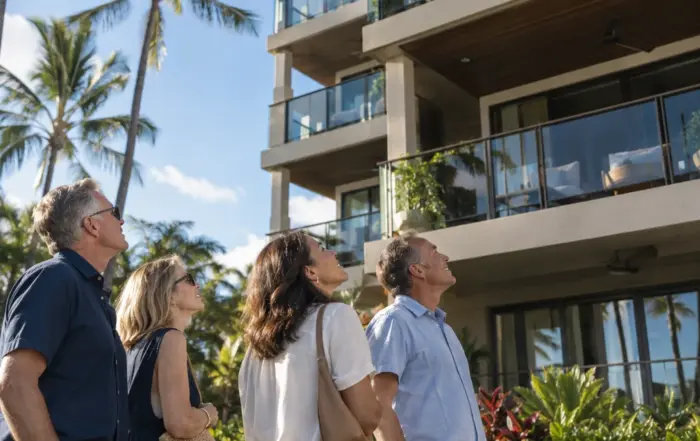
Practically speaking, Lahaina is becoming walkable again in phases. If your home sits within a few blocks of that corridor, plan for foot traffic, guests arriving on foot, and a lanai that functions as a second living room.
Walkable Lahaina Interior Design: Blending Indoor and Outdoor Rooms
Front Street’s charm has always been its rhythm — shop, sidewalk, seawall, ocean, all within a few hundred feet. Homes near it tend to have the same compressed geography: a modest footprint, a generous covered lanai, and sliding or folding doors that blur the line between them. That’s the design problem worth solving first.
Start With the Lanai, Not the Living Room
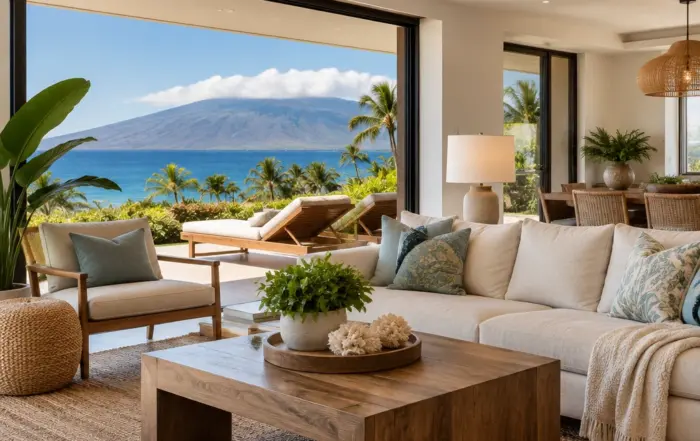
Most furnishing plans we see start inside and treat the lanai as an afterthought. Flip it. On Maui, the lanai is where coffee happens, where remote work happens, where guests gather at sunset. If you choose the outdoor grouping first, you can then match indoor scale, fabric tones and wood finishes to it — and the two rooms read as one continuous space instead of a house with a patio attached.
A few rules that hold up in West Maui’s heat and UV:
- Keep flooring or decking tones continuous across the threshold so the eye doesn’t stop at the door.
- Repeat one material — teak, woven resin, black aluminum — inside and out for cohesion.
- Size the outdoor rug to anchor the full seating group, not just the coffee table.
- Use layered lighting: a ceiling fan plus lamps for the lanai, since Maui County rules require outdoor fixtures to be shielded and downward-facing.
Indoor-Outdoor Furniture for Maui That Actually Lasts
Indoor-outdoor furniture on Maui is a materials question before it’s a style question. Powder-coated aluminum frames, marine-grade stainless hardware, solution-dyed acrylic and performance-weave fabrics all tolerate salt air and intense sun. Solid tropical hardwoods like teak weather gracefully if they’re oiled. What doesn’t survive: particleboard case goods, untreated steel, and inexpensive resin wicker that turns brittle and chalky within two seasons.
If your home is in the fire-affected area or you’re rebuilding, there’s an added layer — many owners are choosing metal roofing, concrete siding and furnishings that reduce fuel load near the structure. We treat that as a design brief, not a sales pitch.
What Furniture Holds Up to Salt Air, Sun and Humidity?
This is the question we answer most often, and the answer is specific to Hawaii rather than generic “outdoor furniture.” Salt air corrodes metal, humidity feeds mildew, and UV bleaches everything that isn’t solution-dyed or powder-coated. Here’s how we specify for Lahaina homes.
Is Rattan or Leather Better for Hawaii?
Both can work — with caveats. Natural rattan and cane are beautiful and appropriate to island architecture, but they need to live under cover, away from direct rain, and they should be sealed. Synthetic performance weave gives you the rattan look with far better weather tolerance on an open lanai. Leather is genuinely good in Hawaii for indoor seating: it doesn’t hold mildew the way some textiles do, it ages well, and it wipes clean. The catch is direct sun — leather will fade and dry out in an unshaded west-facing room, so specify it for interiors and shaded covered lanais, not open decks.
Fabrics, Rugs and Case Goods: What We Specify
For upholstery, we lean on contract-grade performance fabrics — the same category we use in hospitality projects — because they resist fading, staining and mildew. For rugs, performance and indoor-outdoor constructions handle lanai traffic and high-use great rooms; wool is lovely in bedrooms; jute and sisal are risky in humid homes because they can mildew. Case goods should be engineered for humidity: kiln-dried hardwood, quality veneers, and drawer boxes that won’t swell shut in August.
One more consideration for walkable neighborhoods: durability under real use. Sand, wet swimsuits and foot traffic from the beach are the norm. Performance finishes and cleanable surfaces aren’t a luxury here — they’re the baseline.
How Do You Furnish a Lahaina Home From the Mainland?
Many of our clients live off-island most of the year, and a good number are rebuilding Lahaina homes from California, Washington or Texas. You don’t need to be on Maui to furnish a Maui home. What you need is a process.
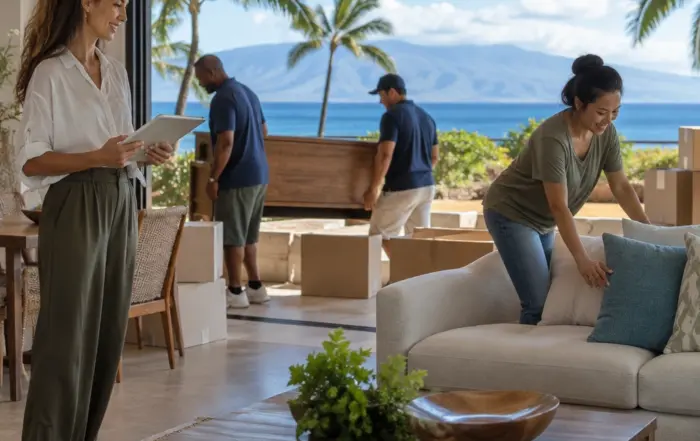
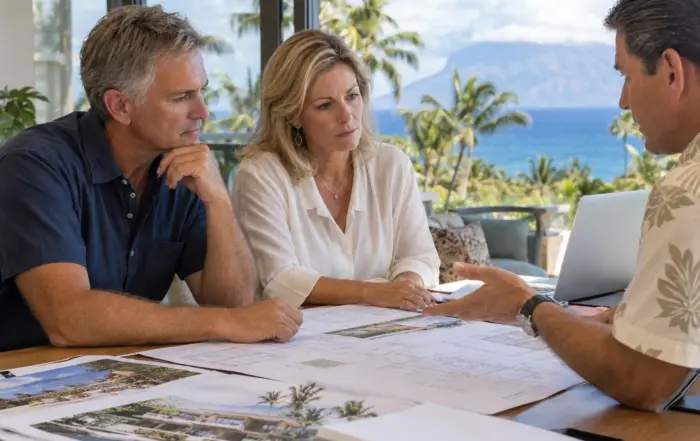
At IDS Maui, projects run remotely through room-by-room composition sheets and 3D renderings approved by email. We handle purchasing, receiving, freight claims and installation while you’re away, coordinate with your property manager, and have the house ready when you arrive. If you’re working with an architect or builder, we plug in early — lighting plans, plumbing and appliance selections, and built-ins are all decided before drywall, and cabinetry, stone and furniture ship to the island months before completion.
The Freight Timeline Nobody Plans For
Production plus freight to Hawaii typically runs 8 to 12 weeks. That means orders placed by August are generally ready for a holiday or January arrival. Miss that window and you’re furnishing a house in pieces across two trips. If you’re targeting a specific move-in date, work backward from it — and don’t forget hurricane-season storage for lanai cushions and lightweight furniture.
Frequently Asked Questions About Furnishing Lahaina Homes
How much does an interior designer cost on Maui?
It depends on scope — a single-room refresh, a full home furnishing, or design involvement through a rebuild. We quote per project after understanding square footage, how much you’re bringing with you, and whether purchasing and installation are included. Call 808-891-8800 for a scope conversation.
How long does it take to furnish a Maui home?
Plan on 8 to 12 weeks for production and freight once selections are final, plus lead time for custom pieces. Quick-ship programs shorten that for in-stock items, which is useful for rentals and interim housing.
Can I furnish my Lahaina condo or home entirely from the mainland?
Yes. Renderings, samples shipped to you, emailed approvals and on-island receiving and installation mean the home can be finished before your first night in it.
Let’s Get Your Lahaina Home Ready for Walkable Living
Front Street is open, the marketplace opens Nov. 10, and the first commercial rebuild is rising at 612 Front St. The street is coming back in phases — and the homes around it deserve furnishing plans built for how Lahaina actually lives: doors open, trade winds moving through, sand on the floor, sunset on the lanai.
Our showroom is Upcountry in Makawao, and we work with homeowners across West and South Maui, including Lahaina, Kaanapali and Kapalua. Whether you’re rebuilding, refurnishing a long-term rental, or setting up a home you’ll only see part of the year, we can walk you through materials that survive salt air, a realistic freight timeline, and a room-by-room plan you can approve from anywhere.
Call 808-891-8800 or email us to start the conversation. Bring your floor plan, your move-in date and your questions — we’ll handle the rest.

Meet Valorie, founder of IDS Maui, who has spent 23 years bringing colorful fabrics, clever space planning, and new technology into homes and workplaces across the Hawaiian Islands, so your project will embody the Hawaiian style.
Need Design Help With Your Maui Home?
Ask us anything — furniture, design, or where to start.