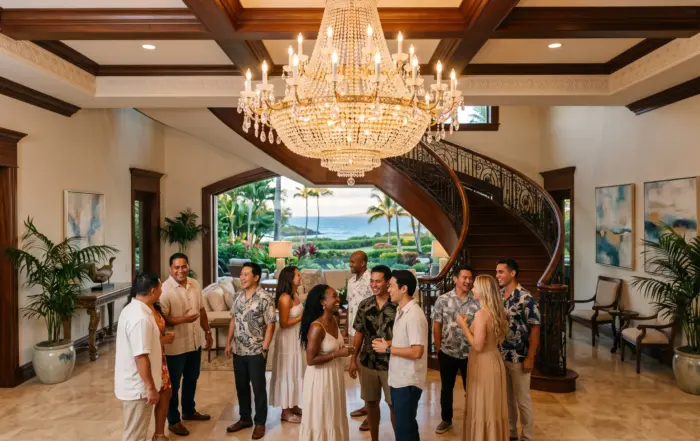
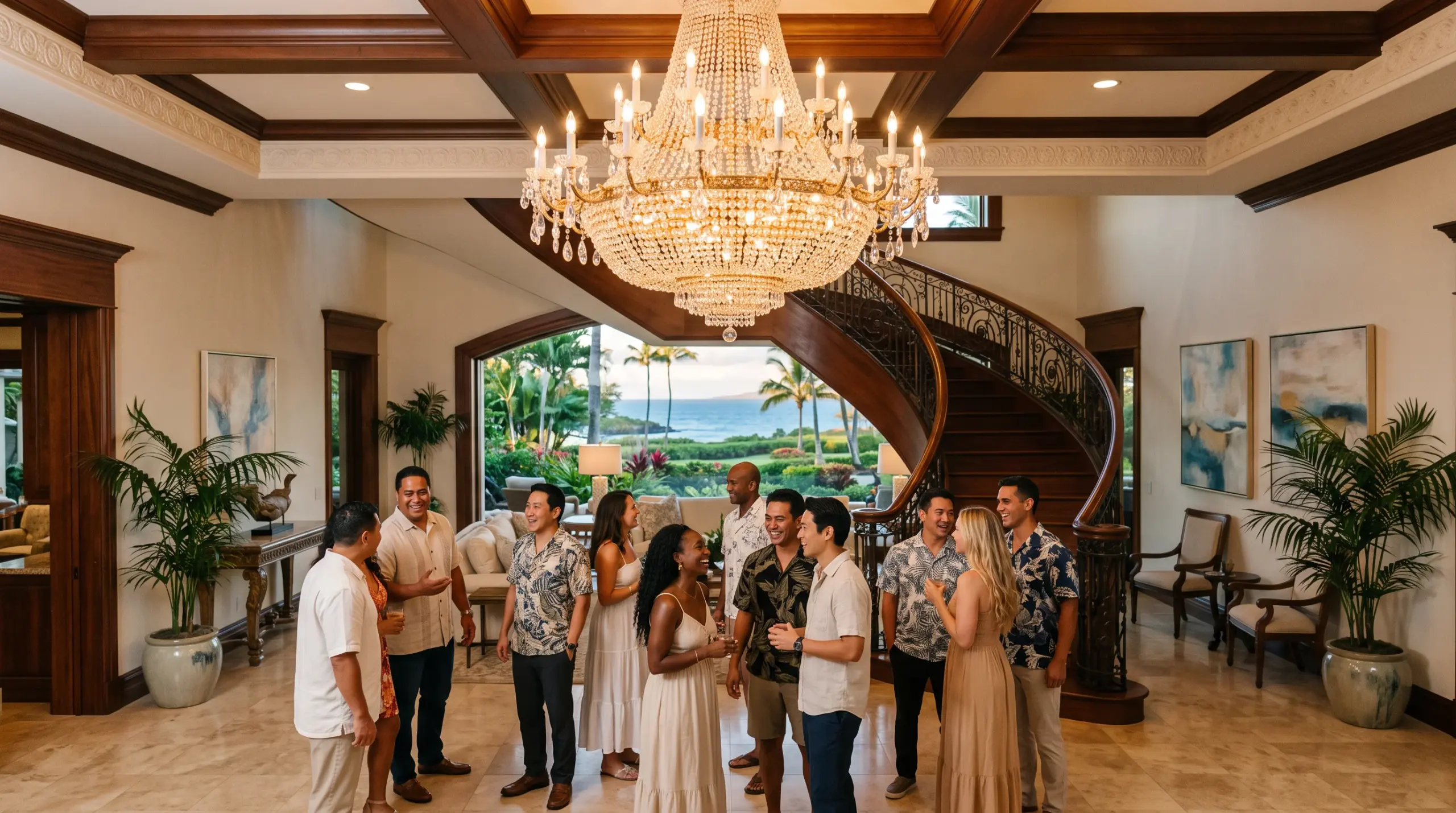
Luxury chandeliers import Maui through a carefully coordinated chain of design approval, international or mainland purchasing, protective packing, ocean or air freight, customs documentation, interisland transportation, and final installation. A chandelier may travel thousands of miles before it reaches a home in Wailea, Kaanapali, Kapalua, Makawao, or Hana, and every stage affects its cost, condition, and arrival date.
For homeowners, the most important point is that chandelier delivery is not simply a matter of ordering a fixture online and paying for parcel postage. Oversized crates, fragile crystals, custom finishes, electrical specifications, insurance, port handling, and Maui’s limited freight infrastructure all require advance planning. This guide explains the chandelier shipping process, how freight for chandeliers to Hawaii generally works, what an interior designer manages, and how IDS Maui helps remote and seasonal homeowners receive high-end lighting with fewer surprises.
By Valorie Spence, ASID, owner of IDS Maui, designing Hawaii homes since 1999.
How Does the Luxury Chandeliers Import Maui Process Work?
The phrase “luxury chandeliers import Maui” describes several different supply chains. The correct process depends on where the chandelier is made, whether it is a stock or custom piece, its size and weight, and whether it is being purchased for personal use or as part of a commercial design project.
From an international manufacturer
When a chandelier is manufactured outside the United States, the shipment normally enters the United States through a mainland or Honolulu gateway before traveling onward to Maui. U.S. Customs and Border Protection classifies chandeliers within the broader category of lamps and lighting fittings; classification, country of origin, value, and intended use can affect entry requirements and duties. CBP’s guidance recommends providing an accurate description, manufacturer, country of origin, composition, intended use, and pricing information when asking for import guidance. U.S. Customs and Border Protection importer guidance explains why complete product information matters.
For a residence, the designer, vendor, freight forwarder, or customs broker may coordinate the commercial paperwork. The exact arrangement varies by seller and purchase terms. A homeowner should not assume that “delivered” includes customs clearance, port fees, insurance, crating, interisland freight, or installation.
From a mainland supplier
A chandelier purchased from a lighting showroom or manufacturer in California, New York, Florida, or another mainland location is usually a domestic shipment once it has cleared any applicable international import process. It still requires specialized Hawaii freight. A large fixture may move by truck to a mainland consolidation point, travel by ocean container or air cargo to Honolulu, and then continue by ocean freight to Kahului.
Hawaii’s freight system is different from a mainland delivery route. State transportation documents identify Kahului Harbor as Maui’s freight port, while Honolulu functions as a central hub for statewide maritime cargo. Most goods used by Maui residents and visitors arrive through Kahului Harbor, which is also used for container storage and general cargo handling. Hawai‘i Department of Transportation freight planning information provides additional context on the state’s cargo network.
That extra leg is why a chandelier scheduled for Maui must be ordered well before a move-in date, holiday gathering, or photography deadline.
What Is the Chandelier Shipping Process from the Showroom to Maui?
The chandelier shipping process begins long before the fixture is placed in a crate. At IDS Maui, the lighting selection is considered alongside ceiling height, furniture scale, sightlines, dimming controls, architectural details, and the microclimate of the home.
- Confirm the design and specifications. The team verifies dimensions, canopy size, hanging height, finish, crystal or glass components, bulb type, voltage, weight, and required support.
- Check the electrical plan. A decorative fixture may require a junction box, reinforced blocking, a transformer, special dimmer, or coordination with a contractor and electrician.
- Confirm availability and production time. Stock, quick-ship, made-to-order, and fully custom pieces have different schedules.
- Arrange professional packing. Crystals, arms, shades, and decorative elements may need separate wrapping or custom foam protection.
- Book freight and insurance. The shipment is routed through the appropriate carrier or freight forwarder, with the value and condition documented.
- Receive and inspect the crate. The receiving team checks for visible damage, photographs packaging, and reports concealed damage according to the carrier’s requirements.
- Deliver and install. The fixture is transported to the property, assembled, secured, balanced, connected, and tested.
Why crating and receiving are so important
Luxury chandeliers are vulnerable to vibration, impact, moisture exposure, and incorrect handling. A crate that looks intact can still contain a cracked crystal, bent arm, scratched finish, or missing hardware. For that reason, freight claims should be documented immediately with photographs of the outer packaging, inner protection, labels, and damaged components.
IDS coordinates receiving, inspection, freight claims, and installation so the homeowner does not have to manage a freight terminal or negotiate with multiple carriers from another state. This is especially valuable for owners who live off-island most of the year.
Ocean freight or air freight?
Ocean freight is often more practical for a large or heavily crated chandelier because it can accommodate greater dimensions and weight. Air freight may be appropriate for a smaller, urgent, or particularly time-sensitive fixture, but dimensional weight can make it expensive. Standard parcel services are not always suitable for oversized or delicate lighting. For comparison, USPS states that domestic parcels are generally limited by combined length and girth, with additional oversized charges and restrictions for large packages. USPS parcel size and weight standards illustrate why high-value chandeliers are commonly handled through specialized freight rather than ordinary parcel delivery.
How Much Is Freight for Chandeliers to Hawaii?
There is no single flat rate for freight for chandeliers to Hawaii. The cost is calculated from several variables, including the chandelier’s purchase price, crate dimensions, actual and dimensional weight, origin, delivery method, insurance value, port charges, fuel surcharges, and final-mile access.
A compact, boxed fixture may have a manageable freight charge. A multi-tier chandelier with a custom wood crate can cost substantially more because the carrier is transporting the crate’s volume as well as its weight. A residence in Upcountry Maui may also require different delivery planning than a condominium in Wailea or a resort property in Kaanapali.
A complete estimate may include:
- Origin pickup from the manufacturer or showroom
- Professional packing or custom crating
- Mainland trucking to the export or consolidation warehouse
- Ocean or air transportation to Hawaii
- Honolulu transfer or interisland cargo handling
- Maui delivery to the property or receiving warehouse
- Transit insurance and claims administration
- Uncrating, assembly, installation, and removal of packing materials
International orders may also involve customs entry, duties, user fees, or other agency requirements. CBP notes that the applicable treatment depends on the commodity, entry type, and mode of transportation; importers may need specialist or broker assistance for specific products. CBP information on duties, taxes, and import fees is a useful starting point, but it is not a substitute for a project-specific quote.
For accurate budgeting, ask for a written estimate that separates product cost, crating, freight, insurance, delivery, and installation. This makes it easier to compare a luxury fixture with a quick-ship alternative and prevents an apparently inexpensive chandelier from becoming expensive after transportation is added.
How Does Maui’s Climate Affect High-End Lighting?
Lighting selection in Maui is not only about appearance. Salt air, humidity, ultraviolet exposure, wind, and temperature variation can affect finishes, metals, adhesives, lamps, and electrical components.
Choose finishes for the location
South Maui communities such as Wailea, Makena, and Kihei are hot and intensely sunny, with salt air near the coast. West Maui locations including Kaanapali, Kapalua, Napili, and Lahaina also require attention to coastal exposure. North Shore and Hana properties are more windward and humid, increasing concerns about rust and moisture. Upcountry communities such as Makawao, Kula, Pukalani, and Haiku are cooler and damper; mildew, fireplaces, and warmer material palettes may influence the design.
An indoor chandelier should still be protected from open-air exposure. Lanai fixtures require products specifically rated for the location, along with appropriate mounting, sealed components, and finishes suitable for outdoor conditions. A beautiful interior fixture should not be installed in an exposed lanai simply because the proportions look right.
Plan for cleaning and maintenance
Crystal and glass collect dust, while coastal air can leave residue on metal surfaces. Maintenance access should be considered before installation, particularly in vaulted great rooms and stairwells. The design should allow safe access for bulb replacement and cleaning without placing unnecessary strain on the fixture.
Ceiling fans, recessed lighting, sconces, and table lamps can support a chandelier as part of a layered lighting plan. This avoids relying on one decorative fixture for every lighting task and creates a more comfortable atmosphere in rooms with strong daylight or high ceilings.
Can IDS Maui Manage Chandelier Delivery for an Off-Island Owner?
Yes. Many IDS Maui clients live on the mainland or outside Hawaii for much of the year. The project can be managed remotely through room-by-room composition sheets, product approvals, finish samples, and 3D renderings reviewed by email.
Once the selection is approved, IDS can coordinate purchasing, receiving, freight claims, delivery, and installation while the owner is away. The team can also communicate with a property manager, contractor, architect, builder, or electrician so that the chandelier is not delivered before the ceiling, wiring, paint, or furniture layout is ready.
Timing is especially important. A custom chandelier may require production time before freight is even scheduled. As a practical planning rule, IDS recommends allowing approximately 8–12 weeks for production plus freight, depending on the manufacturer and shipping route. Orders placed by August are typically better positioned for a holiday visit or January arrival, although schedules can change.
Before leaving a Maui home for the off-season, owners should also address humidity, mildew, salt exposure, termites, hurricane-season lanai storage, and property access. A chandelier cannot be considered successfully delivered until it is safely inside the home, correctly installed, and protected from the conditions of the property.
Frequently Asked Questions About Maui Chandelier Delivery
Does every chandelier come through Kahului Harbor?
No. Smaller or urgent shipments may move by air cargo, while larger fixtures commonly travel by ocean freight. Kahului Harbor is Maui’s primary commercial freight port, but the route depends on the crate, carrier, origin, and delivery arrangement.
Should I order a chandelier before construction is finished?
Usually, yes. The fixture’s weight, canopy, hanging height, junction box, blocking, and dimmer requirements should be coordinated before drywall and final electrical work. Early selection helps avoid costly changes later.
Can IDS Maui arrange delivery if I am not on the island?
Yes. IDS Maui works with remote homeowners and can coordinate approvals, purchasing, receiving, freight claims, property managers, contractors, and installation. Call 808-891-8800 or email IDS Maui to discuss your chandelier, timeline, and property location.
Conclusion: Plan Luxury Lighting as a Maui Logistics Project
A luxury chandelier can define an entry, dining room, great room, or primary suite, but getting it to Maui requires more than selecting a beautiful image from a catalog. The successful process combines design expertise with accurate specifications, appropriate crating, freight planning, customs awareness when applicable, careful receiving, climate-conscious material choices, and professional installation.
Whether your project is in Wailea, Kapalua, Kula, Makawao, or another Maui community, early planning is the best way to protect the fixture and the schedule. IDS Maui manages the details so homeowners can approve the design remotely and arrive to a finished home rather than a crate waiting at a freight terminal. Call 808-891-8800 or email IDS Maui to begin planning your Maui chandelier delivery.

Meet Valorie, founder of IDS Maui, who has spent 23 years bringing colorful fabrics, clever space planning, and new technology into homes and workplaces across the Hawaiian Islands, so your project will embody the Hawaiian style.
Need Design Help With Your Maui Home?
Ask us anything — furniture, design, or where to start.